Hi everyone!
During this unit I was a little confused about what the structures inside the cell do. I have notes on it, but it's still a little hard to follow. If someone could help that would be awesome!
Thanks.
Wednesday, October 12, 2011

Monday, October 10, 2011
Scribe 10/10/11
Hey everyone!!
Today we took lots of notes on what exactly we saw while doing the plasmolysis lab and the enzyme lab. Here they are...
Plasmolysis Lab
- So imagine that inside of the cell, there is 99% water and 1% salt.
- Then, you put that cell into a pool of water, which is 99% water and 1% salt, too. What would happen?? Well, since the combination of water on the inside is the same as the outside, the equilibrium is already reached. However, the cells will still be moving, but evenly (or with no net movement).
- But.... if that cell is in a pool of water with 6% salt and 94% water, water will move from the inside to the outside of the cell because...
THINGS MOVE FROM HIGH (concentration) TO LOW (concentration)!
- Because of that phrase, water will move out of the cell, causing the cell membrane to shrink since when things lose water they tend to shrivel up like you can see in this picture to the right.

- Now, in class we used the red blood cell as an example. What if the cell had 99% water and 1% salt while the pool of water the whole cell is in is 100% water? Water would go into the cell because THINGS MOVE FROM HIGH TO LOW.
- BUT... this time is different. The water will go into the cell and so the cell will expand and since the don't have a cell wall, they'll BURST, which can be deadly.
- That process by which a cell explodes when it is in a higher concentration of water is called cytolysis (cyto-cell, lysis-break open).
Enzyme Lab
- Catalase is most usually found in the blood.
- We would expect catalase to work best, or have the largest amount of activity, at 37ºC (our body temperature, since they are usually found in our bodies).
- Enzymes are NOT ALIVE
- Enzymes are made of proteins, which are also not living and at extreme temperature they get denatured (or broken down).
- What should have happened... The graph for the whole class data should have started off really low and increased so the highest point was at 37ºC and then it would have decreased again... kinda like a hill.
The next scribe will be: Kasia
Saturday, October 8, 2011
Scribe 10/7/11
Today in class we did our Enzyme Lab!
In this lab we had to determine the effects of temperature on enzyme activity. During this lab we used the enzyme which was Catalase and the substrate which was Hydrogen Peroxide Solution. Enzymes are: Proteins that speed up chemical reactions that take place in cells.
Some background information on the lab that we did was... Catalase: Is an enzyme that is found in blood and other cells. It speeds up the breakdown of Hydrogen Peroxide into water and oxygen. Also if hydrogen peroxide is left to build up in the cells, then the hydrogen peroxide turns toxic!!
The Experiment:
During this experiment each lab group had to do different experiments using different materials to find out the bubble activity in the test tubes. This lab took the whole period for our class and was quite time consuming. However, it wasn't that difficult to accomplish the lab. For the results, we did not get group five's results, and the results for group two are a bit off because the average is wrong. Here is a picture of the results. The other two pictures are from the group with 100ºC.


Homework: Finish Enzyme Lab, pages: 24-32
The Next Scribe Will Be: Ereni
In this lab we had to determine the effects of temperature on enzyme activity. During this lab we used the enzyme which was Catalase and the substrate which was Hydrogen Peroxide Solution. Enzymes are: Proteins that speed up chemical reactions that take place in cells.
Some background information on the lab that we did was... Catalase: Is an enzyme that is found in blood and other cells. It speeds up the breakdown of Hydrogen Peroxide into water and oxygen. Also if hydrogen peroxide is left to build up in the cells, then the hydrogen peroxide turns toxic!!
The Experiment:
During this experiment each lab group had to do different experiments using different materials to find out the bubble activity in the test tubes. This lab took the whole period for our class and was quite time consuming. However, it wasn't that difficult to accomplish the lab. For the results, we did not get group five's results, and the results for group two are a bit off because the average is wrong. Here is a picture of the results. The other two pictures are from the group with 100ºC.


Homework: Finish Enzyme Lab, pages: 24-32
The Next Scribe Will Be: Ereni
Thursday, October 6, 2011
Scribe 10/6/11
Homework:
- Finish Lab UP on page 36-37 (page 211 in the book will help)
- Bring goggles to class for tomorrows lab!
Notes: Today we discussed what catalysts and enzyme
s are, and why they're important.
- Catalyst: a substance that speeds up a chemical reaction
- Decrease the amount of energy needed to start the chemical reaction
- After the reaction, the catalyst stays the same way that it started
- Enzymes: proteins that act as biological catalysts
- Affected by changes in pH, temperature, and substrate concentration
- Also makes the reaction faster
Lab Review:
Normal and Plasmolyzed Cells-
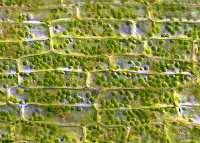
Our job was to make two wet mounts. One wet mount was of an Elodea leaf with two or three drops of tap water on it. The other wet mount was of an Elodea leaf with two or three drops of 6% salt water. After we had added the coverslips, we placed them under the microscope to examine the difference. We were supposed to label the cell wall, cell membrane, and chloroplasts in both cells.
Here are a few images of our results:
First Wet Mount- Normal Cell

Second Wet Mount- Plasmolyzed Cell (6% Salt Water)

It is shown that the first wet mount compared to the second wet mount is very different.
Well thanks everyone! Hope to see you tomorrow!
The next scribe will be: Samantha
Wednesday, October 5, 2011
Scribe 10/5/11
Hello everyone! Today in class we took notes and did a lab.


Homework:
Review for test quiz tomorrow, prelab, finish lab on Up pages 33-35 and remember to bring goggles to class.
Notes review:
Diffusion
- Particles are always moving
- particles move from areas of HIGH concentration to LOW concentration
- Particles move until EQUILIBRIUM is reached
- particles move passively
Osmosis
- DIFFUSION of WATER through a selectively permeable membrane.
Lab Review:
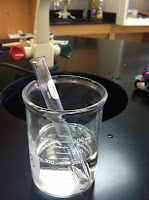
In the lab we did, we tested the diffusion of starch and glucose.

while setting up the lab in the beginning it should look something like this:

Afterwards it should look something like this:
The lab results were that there was iodine in the tube, glucose in the Becker and starch didn't get out.
The next scribe will be... Olivia!
Monday, October 3, 2011
Scribe 10-3-11

This is what we did in class today.
Homework:
We turned in our homework from over the weekend-UP pg. 8-14 and got a stamp on our stampsheet for the organelle chart.
Review:
We talked about the differences and similarities between plant and animal cells.
Plant: large central vacuole, cell wall, chloroplasts
Both: cytoskeleton, mitochondria, cell membrane, nucleus, golgi bodies, vacuoles, lysosomes, endoplasmic reticulum, ribosomes
Animal: centrioles
*However, not all plant cells, such as with the onion cell, have chloroplasts!
And remember-structure determines function!!!!!!
We had small cell quiz with a partner.....and it didn't count!!! Muahahaha!!!!!!
We took a few notes with pictures on organelles.
And then we talked about the homework for TODAY: reading and taking SQ3R notes.

The next scribe will be LUKE
*continues watching the dancing cat*
Sunday, October 2, 2011
Scribe 9/28-9/30
Our homework was to finish 8-14 lab in UP and the chart due monday with 7.2.
Here are some important things that we learned today:
- An important phrase is STRUCTURE DETERMINES FUNCTION: an example Mrs.Stein used was "Is an ice skater built like a football player?"
- We learned the levels of organisms is as followed:
Organism- Dog
Organ System- Respiratory System
Organ- Liver
Tissue- Cardiac Tissue
Cell- Brain Cell
Organelle- Mitochondria
Molecule- H20
Atom- H
Mrs.Stein also asked a very important question...
Why do we care about the Levels of Organisms?
Scientists love to classify, and it is very easy t
o get stuck on the details and miss the big ideas.
Next, we started the Cell Structure and Function Lab. We looked at 5 slides.
One was the elodea leaf,

The next was the human cheek cell:

Then the onion cell:

After that the onion cell with a drop of Iodine:

Next a slide of frog blood:

This lab was very interesting and I enjoyed it very much. Thank you all! Have a magical day!
The next scribe is ....... RACHEL!
Subscribe to:
Posts (Atom)