Showing posts with label SydneyK. Show all posts

Tuesday, March 20, 2012

Muddiest Point

Hi guys!
The only thing I am confused on is how to tell if something is a stem or a root.
If someone could tell me that would be great!

Sunday, March 18, 2012

Scribe 3/16/12


Hey guys!

So on Friday we started off class with the plant of the day and that day we actually had 2 plants of the day!
The first one was the Madagascar Palm ----->

The second was the Sundrew
<--------


Then we finished our labs which are due on Monday!


We also took notes on the Concept of Transpiration, so if you didn't get them here they are!

-Transpiration: the process when water(h2o) moves up through the xylem(which is the structure that transports water throughout the plant body) and out through the stoma(which is the opening between the guard cells that regulates how much water, carbon dioxide, and oxygen comes in and out of the plant body).

- Cohesion: water molecules stick to each other

- Adhesion: water molecules stick to the walls of the xylem.

- *In order for water to have a continuous pull upward, it needs to be able to go somewhere.*

Homework:
1.) Work on textbook readings
- focus on transpiration sec 23.4(end of leaves) 23.5 (first pages only!)
- look at second page of packet for sections to read
2.) Read section 24.1
-Come to class knowing
1) purpose/function of flowers
2) parts of flowers
3) how flowers develop into fruits
4) life cycle of an angiosperm
3.) UP 39 Color/Functions


NEXT SCRIBE IS JANIE

Wednesday, February 22, 2012

Muddiest Point!

Hey guys, I am having trouble telling the difference between amphibians and reptiles and platyhelminthes and nematoda. If someone could help me that would be great!

Tuesday, February 7, 2012

Muddiest Point!!!

Hey guys! This unit has been going pretty well! The only thing I am confused on is the differences between Darwin and Lamark and what they each discovered about evolution. Thanks!

Wednesday, January 25, 2012

Scribe! 1/25


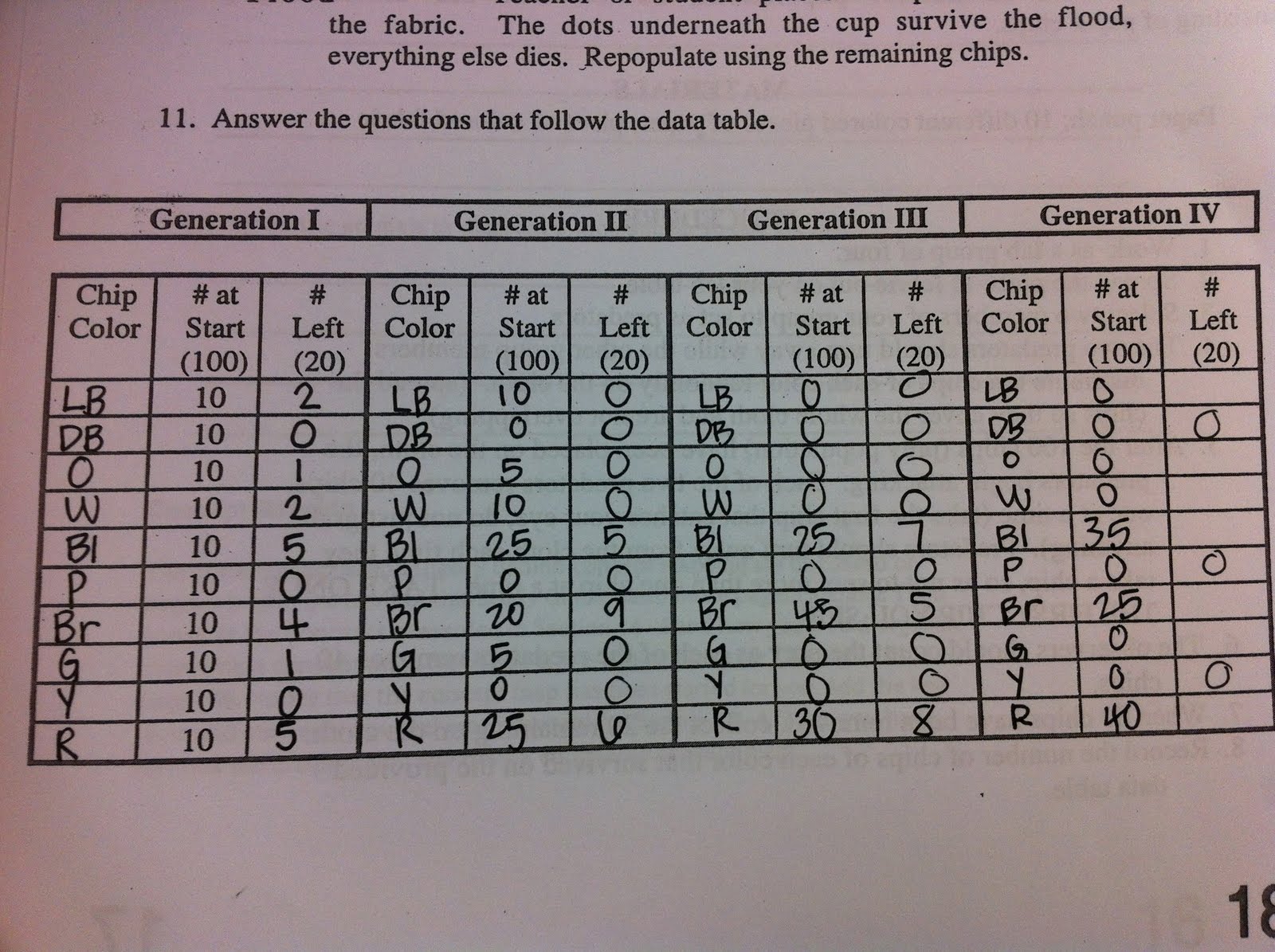
Hey guys! So today in class we began with handing in our Double Bubble Maps on Darwin vs. Lamark. Then we discussed on how the Natural Selection Lab worked and how we were going to do it. *Just incase you guys didn't get the homework it is to finish the Natural Selection Lab, go see Mrs. Stein to get a homework pass if you haven't already, and that the Project on the endangered species is due February 28th.

So this lab is about natural selection and how it is about how organisms vary in their characteristics and how some organisms reproduce and survive better than others. The purpose of the lab is to reinforce the concept of how selection works in a demonstration. Here are the steps to this lab:
1. Work as a lab group of four
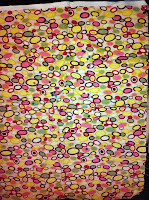
2. Spread the piece of fabric out on your lab table
3. Select two members of your group to act as predators
4. The two predators should turn away while the other group member distribute ten chips of each color randomly on the cloth.
5. After 100 chips(prey population) have been placed on the cloth, the predators begin attacking. Each of the two predators removes 40 chips, on at a time(take the first chip that catches your eye, do not just grab anything.) Predators should turn away from the cloth each time they take a chip, so as not to spot more than one chip at a time. TAKE ONLY THE FIRST CHIP YOU SEE!
6. The observers should count the prey as each of the predators removes 40 chips.
7. When 80 chips have been removed, collect the 20 remaining on the cloth.
8. Record the number of chips of each color that survived on the provided data table
9. Now allow the population of survivors to reproduce by adding four chips of the same color for every chip that remains from the original population.
10. Repeat the above procedure for the second and third generations and record your results pin the same data table. The same predators should be used throughout the exercise.
11. Answer the following questions on the data table
THE CHART OUR GROUP CAME UP WITH IS AT THE TOP OF THE PAGE!
The other picture is also at the top of the page


THE NEXT SCRIBE WILL BE KAITLYN!


Monday, January 9, 2012

Muddiest Point

Hey guys,
I am confused on the same thing everyone else is, the feedback mechanisms and also the hypothalamus gland and what it does.
Thanks

Sunday, December 11, 2011

Hemachromatosis

Genetics of the Disorder- it is autosomal recessive, which means it has the ability of developing an overload of chromosomes.
Signs and Symptoms- fatigue was most common in women and diabetes was most common in men. Other symptoms were joint pain, body weakness, weight loss, and stomach pain. Not everyone who has Hemachromatosis has symptoms of the disease.
Diagnosis and Detection- Doctors look at medical history, they do physical examinations, and routine blood tests. Some types of blood tests are: Transferrin Saturation Test, Serum Ferritin Test, Liver Blopsy, and Molecular Genetic Testing.
Treatments and Therapies Available- the main idea is to rid the body of excess iron. A therapy in which they do this is called phlebotomy. A pint of blood is taken once or twice a week for several months to a year. The earlier it is treated, the better.
Prevalance in the Population- People of Northern European descent are more prone to hereditary hemochromatosis than from over ethnic backgrounds.
Life Expectancy- people with hemochromatosis have a normal life expectancy. Survival may be shortened in people who develop cirrnosis or diabetes mellitus.

Muddiest Point

Hey guys!
The only thing I am confused on is when they say dominant, do they mean that when there is a capital letter that that letter kind of "gets the say" and recessive doesn't because it is a smaller letter? I think I just need clarification on that and then I am good!

Sunday, November 6, 2011

Muddiest Point

Hey guys! The thing I am confused on is the B and T cells and how many different kinds there are. If someone could tell me that would be great!

Tuesday, October 25, 2011

Class 10/25/11

One thing we talked about in class today was Epidemiologists (just incase anyone didn't catch this Mrs. Stein was going to be an Epidemiologist but instead she is here with us!)(An Epidemiologist is a person who studies infectious diseases.) The first Epidemiologist was a British man named John Snow. In 1854, whenever someone got an infectious disease they thought their god was putting a curse on them. But John Snow did not believe this and wondered why the disease was spreading. He made a map of his town and traced the infectious disease to the Broad Street pump, and figured out that the virus was spreading through the water.

Another thing we went over in class today was the correct answer for the lab we did about the infectious disease that went around the school by various people. Here is the correct answer:

Mr.Paek
(science class)

Heather
(drama club)

Ed(carrier)
(bus 37) (bus 37) (math class)

Mr.Wegley Laura Mrs. Dillion

We also talked about some ways to prevent from getting an infectious disease. Some ways are paying attention to your surroundings, carry around Purell, don't share drinks, and most importantly, wash your hands after you use the bathroom.

What is a VIRUS?

-may be pathogenic
-may spread quickly
-NOT a cell
-made out of protein and genetic material
-not living!
-parasites rely on a cellular(they attack cells themselves)host to exist and replicate
-genetic material is not in nucleus(DNA or RNA)
-do not metabolize (use energy) or respond to stimuli
-consist of nucleic acid surrounded by a protein coat called a capsid(protein all viruses are made of)
-genes are expressed by using the machinery of the host they infect(gene expression=making proteins

Viruses come in a variety of shapes:
1. Bacteriophage
2. Tobacco Mosaic Virus
3. Influenza Virus

SORRY THIS POST TOOK UP SO MUCH SPACE!

THE LYTIC AND LYSOGENIC CYCLES:


Wednesday, October 12, 2011

Muddiest Point

Hey Guys!
I am having trouble understanding is the ATP and all the parts of the Photosynthesis.
Thanks, Sydney

Monday, September 19, 2011

Muddiest Point!

The two things I don't understand is primary and secondary succession, and food webs and food chains. The parts I am confused on about the successions are what the difference between them and which areas of ground they occur on exactly. The parts I am confused on with the food webs are which ones the primary producers are and all the organisms up above them and what the difference between food webs and food chains. Other than that the unit has been good and I understand everything else.

Thursday, September 8, 2011

Unit 1 Reflection

I think this first unit went very well. I like how we kind of reviewed the basics and then started doing labs and tests. As many other people have said although I did not do too well on the test, I have learned from my mistakes and I am excited to do more labs and experiments later on in the year!